Smart money reversal (SMR)
The reversal model that brings all the previous concepts together, in six stages.
The smart money reversal (SMR) is a reversal model. It is not an indicator, it is a process. It brings together everything covered in these pages (liquidity, structure, imbalances) and marks the transition from a distribution phase (selling) to an accumulation phase (buying), or the other way around.
A major reversal is almost never a sudden event. It is a sequence (liquidity grab, break, retest) that unfolds step by step, and every step can be read on the chart.
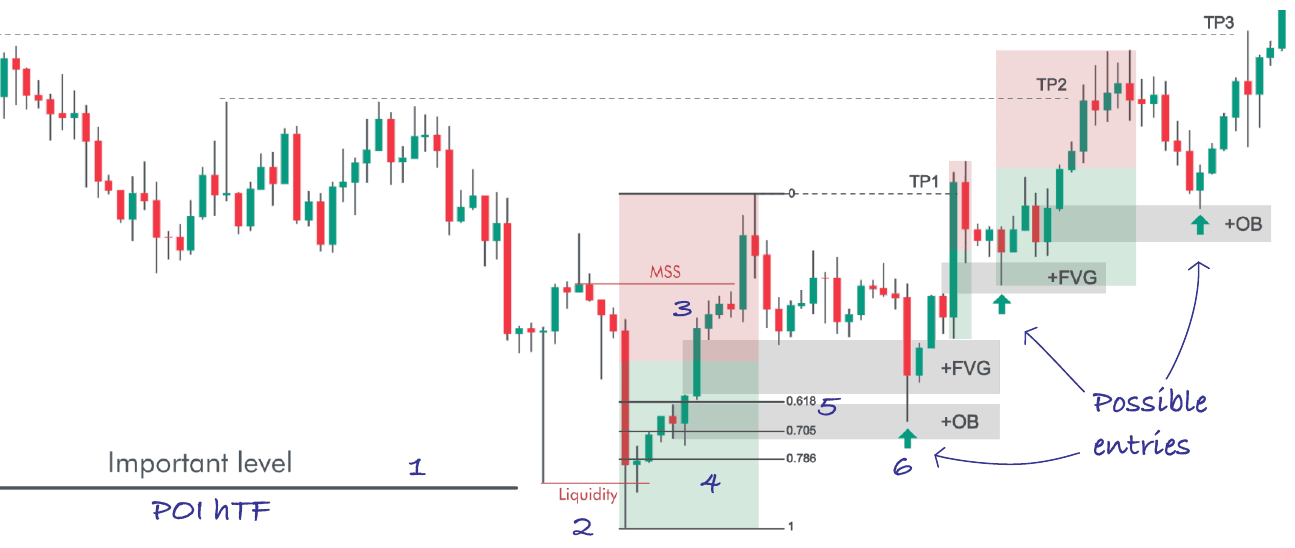
The stages of the SMR
- 1Key HTF level: price enters an HTF POI (an OB or FVG on the Daily or H4), located in a discount or premium zone.
- 2Liquidity grab: price sweeps an extreme, a previous high or low. This is where the dumb money panics and sells, providing the liquidity institutions need.
- 3MSS: during a killzone and on an LTF, structure breaks the other way with strong displacement, confirming the shift in momentum.
- 4Premium and discount: identify the range that tells you where the opportunity will sit.
- 5LTF zone of interest: find the OB, BB or FVG at the OTE level (0.62 - 0.79).
- 6Retest: the zone of interest gets tested. Place your trade. This first long out of the SMR is called the low risk buy (LRB).
Why it is powerful
The SMR is not just another setup: it is the moment several concepts come together in the same place. HTF POI, liquidity grab, MSS, premium and discount, OTE, retest.
When all of these line up with an SMT divergence, the subject of the book, the odds of the market moving in the direction of the SMR are much higher than with an isolated FVG or OB.
It is also an ideal exercise to train your eye: every time you see a major reversal, trace the sequence back and check whether an SMR formed. To do that, start by practising spotting HTF POIs. That is the starting point.
Limits and nuances
The SMR is a probabilistic pattern, not a guarantee. The retest is not mandatory: sometimes price takes off without coming back to test the zone. The MSS has to be clean, with a decisive close, otherwise it is probably a liquidity sweep rather than a real reversal. And without a supportive HTF context, an SMR isn't worth much.
The SMR is the visual signature of a transfer of wealth: the precise moment the smart money absorbs retail panic to launch the market's real impulse.
The rest is in the book
Beat the Market with SMT Divergences
These pages are the first part of the book. The rest answers the two questions that matter: which pair to trade, and when to enter.