Premium & discount range
Where price is expensive, where it is cheap, and the rule that follows.
Defining the range
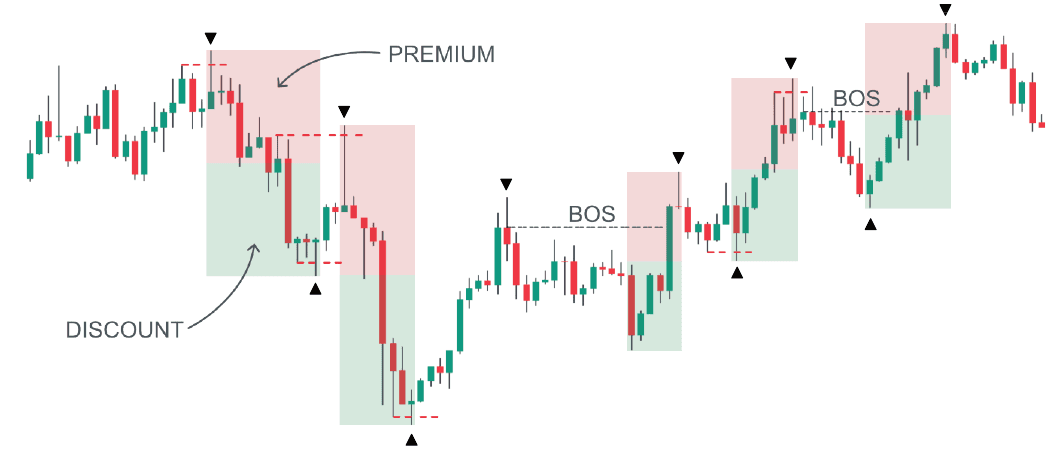
The premium and discount range identifies the zones where it is statistically more advantageous to buy or to sell. It divides a range (a price band) between a swing low, a significant low point, and a swing high, a significant high point.
- Discount zone: below the midpoint, where price is undervalued. Buying is favoured here; the market accumulates before a bullish move.
- Premium zone: above the midpoint, where price is overvalued. Selling makes more sense here; the market often distributes before a correction.
Swing high and swing low
A swing high is a three-candle structure in which (reverse it for a swing low):
- 1candle 2 makes a high above those of candles 1 and 3;
- 2candle 2 closes below the high of candle 1, showing a quick rejection of the breach;
- 3candle 3 confirms the rejection by closing lower.
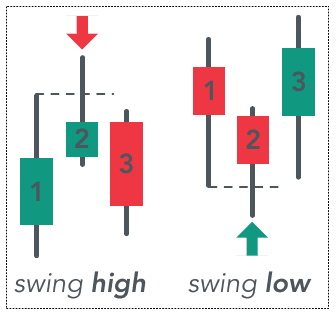
There are several ways to define swing points. I use a stricter approach than the classic definition, which doesn't require candle 2 to close below the high, or above the low, of candle 1. Up to you… but I strongly recommend mine.
The smart money logic
The logic behind discount and premium is simply business logic: the smart money wants to maximise profit by buying low and selling high.
| Zone | Price | Smart money | You |
|---|---|---|---|
| Premium | Overvalued (expensive) | Price comes back into this zone so institutions can sell at the best price | Look for a POI (point of interest) for a short |
| Discount | Undervalued (cheap) | Price comes back into this zone so institutions can accumulate at the best price | Look for a POI for a long |
Non-negotiable rule: long in discount, short in premium, never the other way around. That way you enter in a value zone and optimise your risk/reward.
Choosing a valid range
Choosing the swing highs and swing lows that define the range is crucial. Not all ranges are equal; two criteria make the difference:
- The structure criterion (close to mandatory): a range is only valid if it is bounded by the swings that caused a BOS. No BOS, no legitimacy.
- The liquidity criterion (strongly recommended): favour ranges where one of the extremes has already swept liquidity, that is, run the stops of a previous high or low. That sweep confirms the smart money's involvement and validates the starting point of the range.
Stay flexible: play with timeframes to get a better read of the situation and to see where the liquidity sweeps are. Finding the right range is not always easy when you start. With experience, you will develop an eye for clean structures. The right range is usually the one that jumps out at you.
The market is fractal
Never forget fractality. Every concept repeats, whatever the timeframe. The mechanics are the same, only the scale changes.
On these two DXY charts: on the left, the H4 with its premium and discount range. On the right, the M15 of the same asset, at the same moment, inside the H4 range, where the DXY formed its own two ranges, with their own BOS and liquidity sweeps.
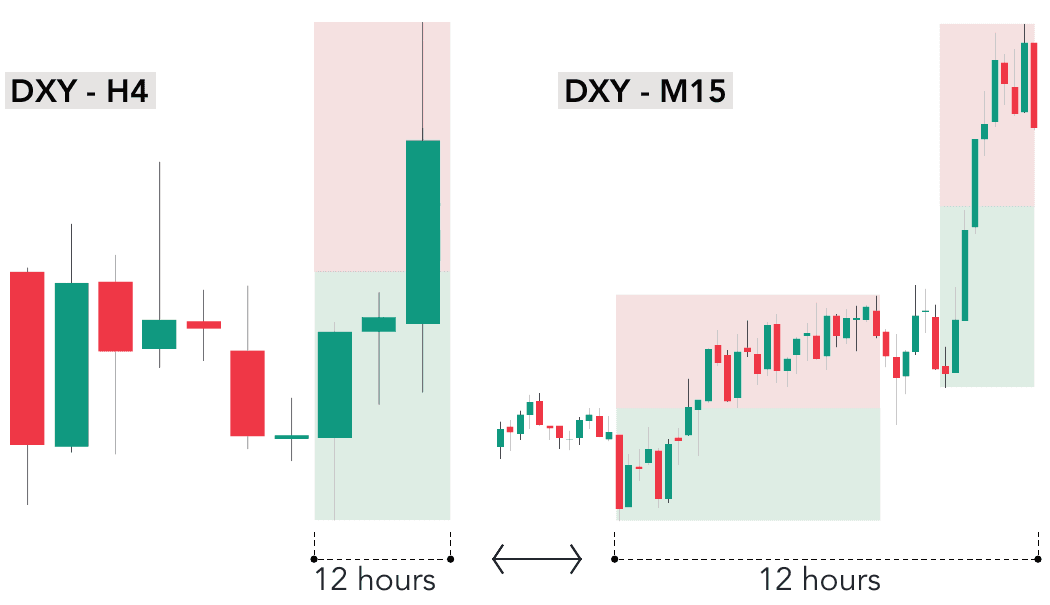
Premium and discount is a context filter. Once the trend is set and the range is drawn, wait for price to come back into your POI before looking for an entry trigger.
The rest is in the book
Beat the Market with SMT Divergences
These pages are the first part of the book. The rest answers the two questions that matter: which pair to trade, and when to enter.