Internal and external liquidity
Where the stops are, why price goes after them, and how to choose your target.
Liquidity is the fuel of the markets: it shows where the orders are, where price wants to go and how it gets there. Spotting FVGs, OBs and the rest is useful, but if you don't know which way the market is heading, it won't get you very far.
The concept
It is simple: price only does two things. It only has two objectives.
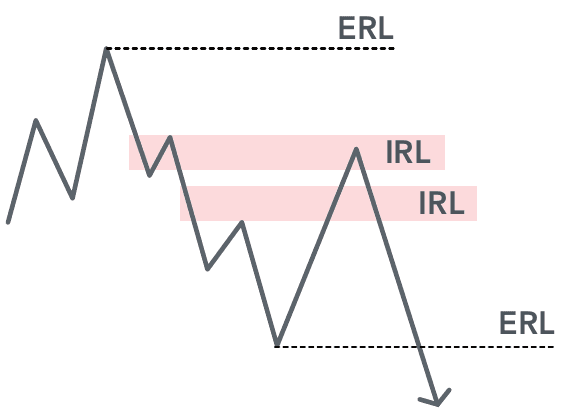
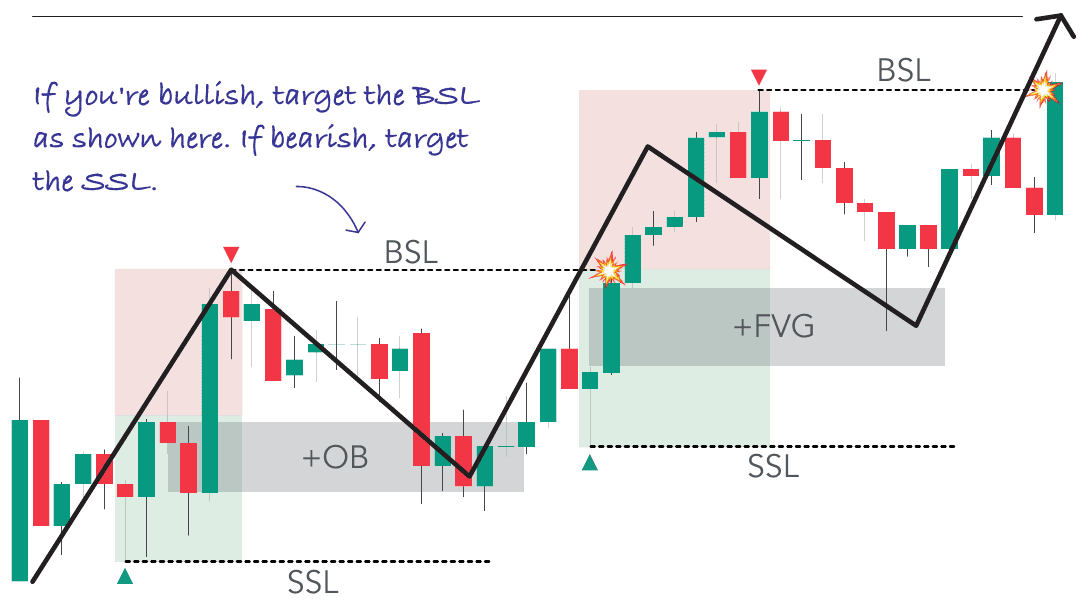
- 1Target an old high or an old low, that is, a range's external liquidity (external range liquidity, ERL). Old highs are buy-side liquidity (BSL), old lows are sell-side liquidity (SSL).
- 2Come back to rebalance an FVG, an OB, a BB, etc., that is, go after a range's internal liquidity (internal range liquidity, IRL).
It all comes down to a simple sequence: ERL, IRL, ERL, IRL, and so on.
What it means for you
You can trade it both ways:
- 1IRL to ERL: you find a POI at the OTE and use it as your entry to target the opposite ERL, your exit objective.
- 2ERL to IRL: once the ERL has been taken, you trade the retracement back to the POI inside the range.
Many traders enter on a POI without knowing whether price is aiming for an IRL or an ERL, and exit too early, or hold too long. Always identify your target before entering, so you know where to take profit before the trade even starts.
In my view, trading IRL to ERL is easier than the reverse, because you are trading with the trend. Trading ERL to IRL means trading against it, and you are mechanically at a disadvantage. In that case, take profits faster.
Liquidity is fractal
One last, fundamental point: liquidity is fractal. What you see as an internal target on the H4 often contains its own complete structure on the M15, with its own external liquidity levels. In other words, internal liquidity on the H4 can very well be external liquidity on the M15. It all depends on the scale you are looking at.
Understanding this lets you build a clear directional bias, frame a scenario, and find consistent entries and exits, whatever the timeframe.

The rest is in the book
Beat the Market with SMT Divergences
These pages are the first part of the book. The rest answers the two questions that matter: which pair to trade, and when to enter.