The stop loss
Where to place it, and why the market comes looking for it.
The stop loss is not just a protective tool to limit your losses. Think of it also as a source of liquidity, essential to how the market works and to how reversals get triggered.
- Every stop loss on a long is a latent sell order (sell stop): to exit a long, you have to sell your asset.
- Every stop loss on a short is a latent buy order (buy stop): to exit a short, you have to buy your asset back.
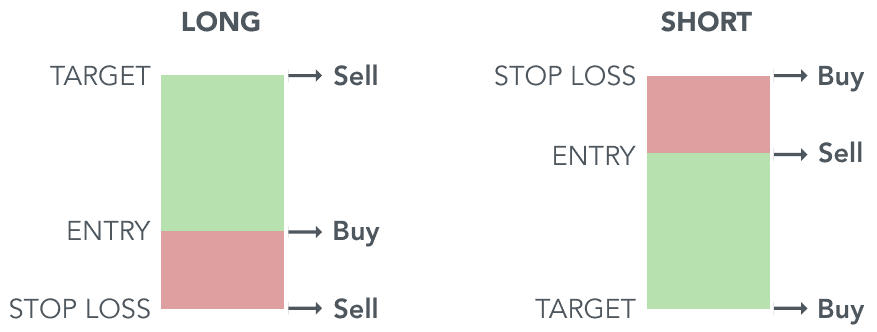
Clustered around key levels (highs and lows, equal highs and equal lows, consolidations), these orders form pools of liquidity that institutional players exploit.
When price reaches these zones, it sets off a cascade of sell or buy orders, providing the liquidity the big players need to open or flip their positions at a lower cost.
Where are the stops?
Suppose the dumb money, the crowd, is bearish and short: after topping out, the asset prints a downtrend, an LH then an LL.
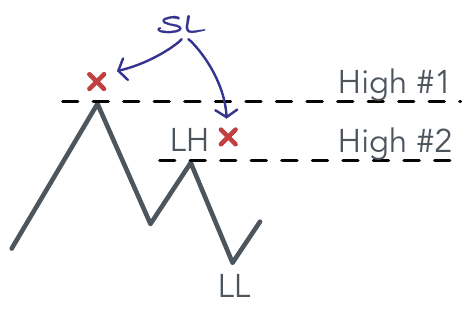
Now ask yourself the real question: where are all the stops? Just above each high marked with a cross. And it makes sense: a downtrend being a sequence of LHs and LLs, as long as it holds, price shouldn't trade back above the last high. So the seller puts the stop right there: if that high gives way, the downtrend is broken, and it is time to get out.
The stop hunt
Unfortunately, it is not that simple. Now suppose the smart money is also bearish. Its orders are too big to short like everyone else: it needs price to trigger the dumb money's stops to get positioned. The stops that get hit create a large volume of buy orders, and that volume is what lets the smart money sell.
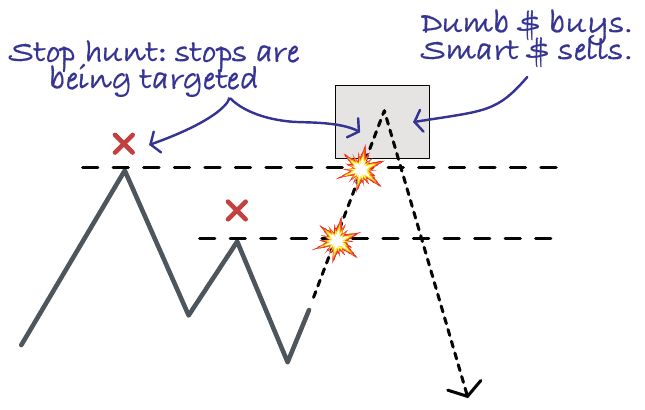
The result: if you had placed your stops like everyone else, they would have been hit, and you would have handed the smart money the liquidity it needed to build its short.
The stop hunt is exactly this mechanism: it is as if the market deliberately went looking for stops sitting at obvious levels, to free up the liquidity the big players need. Once those orders are absorbed, price usually turns back the other way.
You are often told to place your stop beyond the previous high or low, but those zones are also used to grab liquidity, and to take you out. How many times has your stop been hit just before the market went the way you expected? The book shows you where to place it more intelligently, using the protected high and protected low.
The rest is in the book
Beat the Market with SMT Divergences
These pages are the first part of the book. The rest answers the two questions that matter: which pair to trade, and when to enter.